Showing posts with label Venus in Furs. Show all posts

Thursday, August 15, 2013

Joe Marzano's "Venus in Furs"


Directed by: Joseph Marzano 

Starring: Barbara Ellen,
Shep Wild,
Yolanda Signorelli,
Janet Banzet 

Released: 1967 

Language: English 

Length: 65 minutes


As I mentioned in a previous review, when it comes to movies with FemDom themes, “Venus is Furs” is a popular film title. I have no less than four movies by this name in my FemDom film collection. Yet surprisingly, the four movies have almost nothing in common.  

In 1967 sexploitation producer Lou Campa hired Joe Marzano to work on a bizarre little movie called “Cool it, Baby.” After making 16mm shorts throughout the 50’s, Marzano found work in the 1960’s as an editor for an outfit producing industrial films. One of these pictures, “To Face Life Again”, was an unusual documentary about disfigured accident victims readjusting to life. There he met Lew Waldeck, the editor of a series of low-budget soft-core films. Soon enough, Waldeck introduced Joe Marzano to the world of sexploitation.   

Declining cultural barriers were allowing more and more on-screen nudity. From the relatively high-profile Russ Meyer (“Faster, Pussy Cat! Kill! Kill!”) to the lesser-known film-makers such as Joe Sarno, each produced films based on their private fetishes and desires, normally backed by financiers who were willing to bankroll titles that often had little or nothing to do with the finished picture. Without script or concept, a producer would assemble a crew of inexpensive, hungry talent and tell them, “I want a sex film called ‘Cool It, Baby’ or ‘Venus in Furs’” and it was their job to make it happen.   

This was truly the golden age of American sexploitation, when a director could make a feature film for $10,000 and be allowed to follow his own private obsessions wherever they happened to take him, and perhaps end up with an odd little gem. Granted most of what was made was substandard and generally dismissed as trash but some of the sexploitation directors worked from true creative expression. Joe Marzano was such a man.   

Through Lew Waldeck, Marzano met Lou Campa, a director of numerous exploitation films. Waldeck was given $12,000 to make a picture, and was told whatever he didn’t spend would be his salary. Given that enticing stipulation, he made “Cool It, Baby” in 1967 for $7,000. Waldeck hired Marzano and Campa to help make the picture. It was filmed with a lone stationary camera on a tripod. The film ultimately had no real director, and screenwriter Lou Palisano delivered an unfinished script which was fleshed out by Marzano. Joe stayed on as an actor and directed some sequences, Waldeck directed others, and Campa directed the rest. None of them cared about who got credit seeing they were going to split $5,000 between them for a couple days work.   

When I ordered my copy of Marzano’s “Venus in Furs”, it was released on the ‘Something Weird’ label. The DVD contains 3 movies, including “Cool it, Baby”.
 
 
I fast forwarded through the film, "Cool it, Baby”, stopping here and there to get a feel for the movie, and I was surprised at how amateur it was. “Cool it, Baby” has some S&M themes but nothing that is in the least erotic or sexy. It has a cruel female lead but the film has more to do with forced female slavery, drug use, bizarre rituals, laughable whipping scenes, and a court trial filmed in someone’s office complete with office desk and filing cabinets. It is a terrible film but surprisingly it turned a profit. I guess there were enough men hungry for S&M themed movies in 1967 that even the lamest of films could turn a profit with the right kind of promotion.   

Not only did he help write and direct “Cool It, Baby”, Marzano brought most of the cast onboard himself. All of which impressed Campa, who had already secured $10,000 for his next project, a sexploitation film based on the Sacher-Masoch novel “Venus in Furs”. So Campa hired Marzano to direct it.   

Marzano’s “Venus in Furs” was a big artistic advance over “Cool It, Baby”. Able to control the lighting, Joe was free to experiment with the photography, and had two cameras at his disposal. With Lew Waldeck off shooting another picture, George Cirello stepped in as cinematographer, but Marzano did a lot of the photography himself. He brought back several of his friends from “Cool It, Baby” and completed the post-production work, editing and sound mix on his own.    

He had a five day shooting schedule so Joe got together with his friend Barbara Ellen (who played a blackmail victim in “Cool It, Baby”) to write the screenplay. It was Ellen who had the brilliant idea of incorporating the opening scene of the Sacher-Masoch novel into a fantasy sequence in the film. Marzano’s “Venus in Furs” combines sexploitation, creative and artistic film making, and quite a bit of surrealism. Some have made the observation that the film bears similarities to the movies that Marzano’s friend Paul Morrissey was making for Andy Warhol at the time. Perhaps that was his inspiration.   

Marzano’s “Venus in Furs” opens with a close-up of a woman’s leg as she slowly and seductively removes her stockings. She drops them on a naked man who is lying on the floor. Then we see another stocking landing on him, then another, and another as we hear a female voice who paraphrases the words of Venus in the Leopold von Sacher-Masoch novel “Venus in Furs”; 

“You are the one who desires, we are the ones who are desired. This is woman’s entire advantage.”  

Then we hear the voice of another woman, “Do you have this in higher heels?” 

More stockings land on the naked man as he seems to be drifting off into subspace. We hear again from the first woman as she continues to paraphrase Venus,  

“There’s something in you that makes me want to punish you, subdue you, DOMINATE YOU!”  

Then we hear the other woman and then a third woman, we hear all three women’s voices as they alternate sentences. “You shall be bound, bound with stockings, helpless, gagged, put underfoot, lashed, unloved, until you can love, then you can kiss my breast, my mouth, but first my toes. Kiss my toes! You shall be our slave, without illusion, but first you shall feel the pressure of my foot, without mercy.”  

We see three sets of female legs touching the man, teasing him, one pressing her foot against his face, as we hear a repeat of the women taunting him with their words.


“You are the one who desires, we are the ones who are desired. This is woman’s entire advantage. Do you have this in higher heels? There’s something in you that makes me want to punish you, subdue you, DOMINATE YOU! You shall be bound, bound with stockings, helpless, gagged, put underfoot, lashed, unloved, until you can love, then you can kiss my breast, my mouth, but first my toes. Kiss my toes! You shall be our slave, without illusion, but first you shall feel the pressure of my foot, without mercy, WITHOUT MERCY!” 

And with that the film’s title “Venus in Furs” fills the screen, along with “A film by Joe Marzano, suggested by a novel by Leopold von Sacher-Masoch.” It was wise that they used the term “suggested” instead of “based on” because after the upcoming scene and its accompanying dialogue, the only connection between the book and the film is the title.  

Following the opening credits, we see a woman adorned in a fur coat sitting on a couch next to a fireplace, with a man (the same man we saw in the opening) on his knees before her, kissing and worshipping her feet and her legs.


Following Barbara Ellen’s idea, their dialogue is right out of chapter one of the Sacher-Masoch novel (paraphrased a little to give it a more modern meaning).  

It is the dialogue between the book’s author and the Goddess Venus (played by Ellen). Marzano’s first choice to play Venus was the young Warhol actress Mary Woronov, who appeared in “Chelsea Girls” a year earlier. Although she’d expressed interest in doing it, Marzano decided against hiring Mary because the Warhol crew had a reputation for being unreliable. Therefore he cast Barbara Ellen for both the roles of Venus and the female lead character, Marna.  

Getting back to the Venus scene, the fur clad Goddess and her submissive admirer discuss love and the female nature. An example of the rather lengthy dialogue goes like this,  

"You are a divinity, but nonetheless a woman and, like every woman, cruel in matters of love." 

"What you call cruelty, is simply the element of passion and sensuality which is part of woman's nature, and which makes her give herself whenever she loves, and love everything that pleases her." 

If you have a foot fetish or if you’re a fan of watching a man grovel and worship a woman’s feet and legs, you will no doubt enjoy both this scene and the overall movie, as there are numerous foot worship, leg worship and trampling scenes in the film.


In my opinion a better title for the movie might have been “Fetishes” as the film portrays a variety of unusual sexual kinks. (Campa wanted to name the film “Cherished Women”). 

I must say that I really liked both of the opening scenes in this movie. Very well done for a 1960’s sexploitation film. They are of course the fantasies of a submissive male, David, and we meet him as he wakes up from his dreams, with the book “Venus in Furs” lying on his chest. David has the perfect job for a submissive man with a foot fetish, he is a shoe salesman. 

David takes the subway to work, all the while he fantasizes about worshipping and kissing the shoes of the women he sees on the train. He arrives at the shoe store and he obviously loves his job as he gets to serve women by kneeing before them and helping them try on various shoes.


We now know part of the meaning of his fantasy in the opening scene with the one woman’s voice taunting him “Do you have this in higher heels?”. 
 
After he gets off work, David goes to the New York Public Library. Before he enters, five young women run past him. (Marzano had a Fellini-esque vision of dozens of girls running toward the camera. Campa agreed and lined up the talent, but on the day of the shoot he arrived with just three women. After making a few phone calls, Marzano rounded up two more for a total of five.) 
 
Once inside the library, David is browsing books when he happens across a beautiful and mysterious woman, Marna (wearing a fur stole).  
 
He gives her a drive home to a secluded house in the country. She flirts with him but doesn’t permit him to kiss her. She invites him inside her sprawling Gothic mansion but tells him he will have to wait to kiss her. She offers for him to spend the night in a spare room. By this time the movie has taken on a distinctly dream-like quality. David wanders the hallways, hearing people behind all the closed doors. He goes door to door, peeking inside where he observes people engaging in a smorgasbord of fetishes and unusual sexual practices.  
 
In one room there is a muscular man, clothed only in his underwear, he is blindfolded and needs the use of a cane to stand. He has a tin cup in his other hand and several women, one by one, come into the room, drop a coin into the cup and then fondle his body. Perhaps this was a 1967 version of a CFNM fetish. 
 
In another room, David witnesses a woman tied to the bed and two other women are spanking her with their shoes. In another room there is a man removing the boots off of a woman’s feet. He then licks and kisses her feet before lying on the floor where she tramples him. In yet another room we see a masked woman giving a naked woman a milk bath. She pours milk all over her body, scrubs her body and after the bath, she pours milk into a saucer and forces the naked woman to drink it like a cat.


While this is going, David finds a book of photographs which obviously disturb him, although we don’t know what the book contains. 
 
The next day David meets up with Marna and he witnesses first hand her dominant nature. She is playing ping pong with a gentleman wearing glasses and whenever she scores a point, she makes the man kneel before her and she hits him on the head with her paddle. She also forces the ping pong ball into his mouth. Later in the match, she strikes him across the face with her paddle.
 
Next, Marna plays a game of chess with David. During the game a blonde woman sits down at the table to watch the chess match. Marna takes David’s Queen and drops it on the floor. She orders David to “pick it up”. He hesitates so she forcefully reiterates, “I said PICK IT UP!”


David bends down to fetch the piece when Marna kicks it under the table. David crawls under the table and Marna tramples him with her shoes, stepping on his hands with her heels. As she is doing this Marna begins to kiss the blonde woman as they are both obviously turned on by Marna’s dominance and David’s humiliation. 

Other bizarre things occur at the house such as the reading of children’s stories, and finally the climactic orgy scene. The orgy scene is more fetish-driven than sex driven. It’s more like a fever dream. There are people dancing while a woman rides an exercise bike in the middle of the room.


There’s a man in drag dancing with a woman. We see ‘objectification’ taking place as a woman is lying on the floor being used as a card table while another woman obsessively deals cards onto her body. 

There are couples making out and writhing on the floor, all fully clothed. This was common enough in 1960s sexploitation movies and usually looks silly, but in this case it adds to the overall fantasy quality and surrealism of the film. It’s as if the people are driven by something more powerful than sex.  

For his part in the orgy, David is totally focused on watching Marna. He makes his move and he begins to undress her (although she never becomes completely naked). He begins to kiss her but she pushes him away and orders him to kiss her toes. David removes her shoes and he worships her feet (yet another foot worship scene).


He works his way up her body, hoping to finally kiss her on the mouth but just before he does, the blonde woman from the chess match appears and kisses Marna instead. Marna kisses the woman back as she pushes David away with her hand. Once again David is humiliated and frustrated. 

The next day, David is about to leave when Marna once again flirts with him. She tells him that she’s sorry they were interrupted at the orgy because she is attracted to him and she was hoping he would make love to her. David again falls for her seduction so they leave together and go horseback riding in the country. David loses sight of Marna and comes across her making out with the blonde woman up against a tree. David is furious and accuses her of deceiving him. Marna grabs a riding crop and attacks David.


David fights back and wrestles Marna on the ground. The blonde woman tries to help Marna fight David off (although it looks like all she really wants to do is crawl around in the mud). David gains the upper hand and subdues Marna. He begins to kiss her and acts as if he is going to have sex her, right there in the woods, with the other woman watching.  

But then we see David tied to the tree, tied with women’s stockings. The women are lying on the ground looking at him, and the people from the house are standing at a distance taking in David’s humiliation. 

As he is tied to the tree with a look of subspace on his face, we hear the women from the beginning of the film and realize the first woman’s voice is that of Marna. She recites the same words from the beginning of the film, 

“You are the one who desires, we are the ones who are desired. This is woman’s entire advantage. There’s something in you that makes me want to punish you, subdue you, DOMINATE YOU! You shall be bound, bound with stockings, helpless, gagged, put underfoot, lashed, unloved, until you can love, then you can kiss my breast, my mouth, but first my toes. You shall be our slave, without illusion, but first you shall feel the pressure of my foot, without mercy, WITHOUT MERCY!” 

Suddenly we see David sitting outside the New York public library. It is apparent the entire episode was just another one of his fantasies. He gets up and wanders around the streets when he sees a car pull up. He looks inside the car and there is a woman wearing a fur stole and a fur hat. She raises her head and looks at David. The woman is Marna. Perhaps his ordeal wasn’t a fantasy after all.


I definitely enjoyed both Jess Franco’s and Massimo Dallamano’s “Venus in Furs” better than this one. However, to be fair, it really is apples and oranges. When you review a low-budget Lou Campa sexploitation film you go into it with very low expectations. This version of “Venus in Furs” was undoubtedly not at all the sort of movie Campa had in mind when he commissioned Marzano to direct it. It is in fact a somewhat artsy film, admittedly an artsy film about fetishes, kink and sex, but it’s an artsy film nonetheless. This film is a strange but oddly engrossing mix of Sacher-Masoch, Fetishism, FemDom and surrealism. As you probably know by now, I like surrealism in movies.   

There’s a peculiar quality to the eroticism in this film, a kind of thwarted sterile quality. The plot is sketchy, but that seems more of a strength than a weakness, contributing to the feeling of events moving endlessly like recycled dream images. And I thought that Barbara Ellen, who co-wrote the script, played Marna in a delightfully dominant way. There’s very little nudity and no graphic sex, but the movie still manages to be very kinky and definitely expands the boundaries of societal sexual norms. That’s true whether you watched in 1967 or 2012. The film is in constant danger of taking itself too seriously, but Marzano comes up with enough striking and disquieting images to justify its pretensions to being a genuine art film. 

It’s not a great movie by any stretch but it’s well done given its pittance of a budget. Despite its shortcomings, this “Venus in Furs” is a fascinating example of an artist at odds with the sexploitation genre. Marzano wanted to make a real movie and he was obviously connected to the source material, Sacher-Masoch’s kinks and fetishes. Some have said that Joe Marzano was a conceptual and physical fusion of Orson Welles and Hugo Haas. Given the opportunity and freedom, Joe Marzano might have easily been a respected, major American filmmaker. 

Campa made a few more sexploitation films before his descent into mob-financed hardcore. Joe Marzano, on the other hand, never directed in 35mm again. He photographed Lloyd Michael Williams’s experimental “Line of Apogee” (1968), and worked as an assistant director on Jack Glenn’s unreleased “House of the Seven Gables”. He even went back to Campa and sold him a script called “The Leather Girls”, about an all-girl biker gang that may have been sparked by Russ Meyer’s “Faster Pussycat! Kill! Kill!” Campa never shot it, but Joe made an abbreviated version in the late 70’s in super-8mm.  

He continued in super-8 into the 80’s but even super-8 became unaffordable, and Joe Marzano went on to make a proliferation of short films on videotape up until his untimely death in the summer of 2000. Many of his fans considered “Venus in Furs” to be his finest work.


Rating: 3 out of 5 stars


Thursday, July 25, 2013

Jess Franco’s “Venus in Furs”


Directed by: Jess Franco 

Starring: James Darren,
Barbara McNair,
Maria Rohm,
Klaus Kinski,
Dennis Price,
Margaret Lee

 Released: 1969 

Language: English 

Length: 86 minutes


The first movie I ever reviewed for the e-zine Predominant (February 2005) was the 1994 Dutch film version (dubbed in English) of the Sacher-Masoch classic novel “Venus in Furs”. Some time had passed before I received any feedback about that review however a gentleman wrote me, a self-proclaimed film connoisseur and an equal lover of cinema (especially independent films), to inform me that he had purchased a copy of the movie based on my lukewarm (3 stars) recommendation.  

Upon watching the film, he only gave the movie 2 stars at best and he mailed me his copy of the 1969 Jess Franco version of “Venus in Furs”. This gentleman was a fan of Jess Franco comparing his style of film making to that of David Lynch with his usage of dreams and dream-like imagery within his works. David Lynch’s “Mulholland Drive” is one of my all-time favorite films, therefore I was eager to observe Jess Franco’s version of “Venus in Furs”. I considered reviewing it for Predominant but since I had already reviewed the Victor Nieuwenhuijs and Maartje Seyferth’s Dutch version, I decided to watch Franco’s film version purely for my own personal enjoyment.  

As I viewed the film, my first though was “this movie has nothing to do with Sacher-Masoch’s book” which disappointed me and probably prevented me from being totally objective about the overall quality of the film. The DVD had some nice extras, including an interview with Jess Franco about the movie, but I must confess that I never bothered to watch any of the extras at that time. I mailed the movie back to the gentleman who so kindly loaned it to me, and I gave him what was at the time my honest opinion of the film, including expressing my disappointment that Franco used the title “Venus in Furs” when the plot had nothing at all in common with the Sacher-Masoch book.  

Now fast forward several years later. I was seeking possible movies to review and I came across Jess Franco’s film “Succubus” on Amazon. The premise looked very promising; 

“Janine Reynaud plays Lorna, the star of an underground nightclub's Grand Guignol theater who harbors a dark, haunting secret. She performs elaborate S/M fantasies nightly with a bound naked couple before she pretends to kill them, but she's losing her grip on reality. Dreams, flashbacks, and erotic fantasies blur with her waking world and pretty soon she's murdering her sexual partners for real... or is she? The answer may have something to do with a furtive stranger on the fringes of her consciousness and a plot to drive her insane, but it's hard to tell for sure. Sexploitation master Jess Franco creates an alienated but gorgeous vision of the decadent grotesque-chic world of European high society with oblique camera angles, distorted images, and disorienting editing, turning a kinky erotic thriller into a heady (if abstract) psychological fantasy.” 

This synopsis rekindled my interest in Jess Franco, therefore I decided to order both movies. I viewed “Succubus” first but I didn’t care for it. Then with much hesitation, I forced myself to pop the “Venus in Furs” DVD into my player. Since I had seen the movie a few years prior, the first thing I watched was the Jess Franco interview. This gave me an entirely new perspective on the movie, and a new respect for Franco as a filmmaker. 

Jess Franco is a big lover of jazz. Franco’s original title of his “Venus in Furs” movie was supposed to be “Black Angel”. Franco loves to talk with jazz musicians and one time he was having a casual conversation with jazz musician Chet Baker and Baker shared with Franco how he will often gain his inspiration from someone in the audience, usually a woman, and he will focus on her while he performs.  

Franco wanted to make a movie about a black trumpet player who is inspired by an attractive white woman he sees during one of his performances. His idea for the film was to have the musician fall for the woman yet she is both mysterious and elusive as she comes in and out of the clubs where he performs. Franco wanted the jazz music to be the core of the film, while his trademark dream-like sequences portrayed the erotic nature of the interracial romance between the trumpet player and the mysterious woman.  

When he pitched his idea to film producer Harry Alan Towers, Towers informed Franco that in order to get the funding to shoot the film, Commonwealth United had several conditions. They wanted the film to have the title “Venus in Furs” and the female character had to be shown wearing furs throughout the film and that image had to be on the movie poster and in the trailers.


Obviously Commonwealth United wanted to capitalize on the budding submissive nature of man and figured a film with the same title as the famous Sacher-Masoch novel would increase box-office sales. One wonders why not just make the Sacher-Masoch book into a movie but I guess back in 1969, showing a woman whipping a man was still considered controversial, therefore they decided to tease but not please its submissive male targeted audience.  

Another problem the studio had with Franco’s story was his idea about a black trumpet player having sex with a white woman. They wanted to eventually market this movie to international markets, including America, and they felt this was also a taboo subject. Franco relented and re-wrote the film to incorporate these changes while still holding true to his idea about the jazz music being the core of the film.

Franco commissioned the popular British rhythm and blues band, Manfred Mann, to do the soundtrack and in order to conform to the studio’s wishes he decided to make the male lead a white trumpet player who has a sexual relationship with a black female jazz singer (reversing the interracial dynamics of his original idea). In a sign of the times of where society was morally in 1969, the producers of the movie had no problem with scenes of a white man in bed with a black woman but they were dead set against showing a black man in bed with a white woman. Franco decided to split the persona of his original idea of the female lead into two women and have the trumpet player romantically involved with a black jazz singer, yet he falls for a mysterious woman, a white woman named Wanda who would be the Venus (adorned) in furs, the way the movie studio demanded.  

Franco cast former teen idol and American actor James Darren (“Gidget”, “Guns of Navarone”) for the lead character, Jimmy. At first Franco thought Darren’s boyish good looks and conservative image was not a good fit for the role. However, when Franco learned that Darren was a gifted trumpet player in real life who personally knew Chet Baker, he gave Darren the role, as Franco was convinced that Darren could channel Chet Baker in his portrayal of the trumpet player. Franco also cast talented singer Barbara McNair as Rita and sexy Maria Rohm as Wanda. For the supporting roles Franco went with two actors that were regulars in many of his movies, the always controversial Klaus Kinski and the talented British actor Dennis Price.  

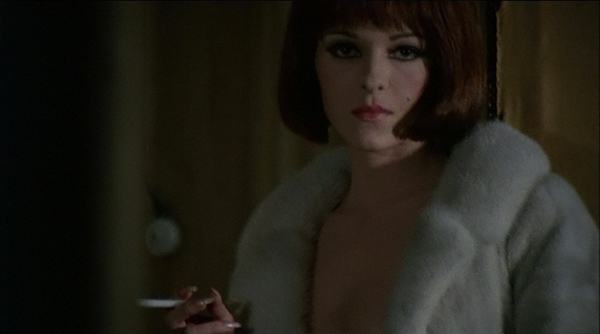
With the required studio changes in place, the story follows trumpet player Jimmy Logan as he falls in love with Wanda Reed, a woman whom he saw once at a cocktail party where he was performing. The movie begins with the opening credits showing a partially naked Maria Rohm in a fur coat while she seductively smokes a cigarette.


The movie opens with Jimmy playing his trumpet along a beach in Istanbul, Turkey when Wanda’s body washes up on shore. Although she is dead, he has a revelation that she is a woman he had recently met at a party.  

In a flashback, we see Jimmy performing at a cocktail party (whose guests are what Jimmy refers to as the ‘Riviera Greek Island crowd’) when he notices Wanda (entering the room wearing a fur coat) and he is immediately attracted to her. He tries to make his way over to meet her during a break but Wanda is also being seduced by a woman, Olga (Margaret Lee), a fashion photographer. Wanda is approached by a millionaire playboy, Ahmed (Klaus Kinski) and she begins to kiss him (giving us the impression that the party is being held at his house and he was the one who invited Wanda to his party).  

Ahmed leads Wanda to a dark room where he watches as Olga and an older wealthy socialite, Percival (Dennis Price), rape Wanda and engage in unconsenual sadomasochistic sex. Jimmy follows Wanda and watches the unusal sexual encounter unfold from a distance as Olga whips Wanda into submission. Wanda screams and rolls around on the floor trying unsuccessfully to escape the bite of Olga’s bullwhip while Ahmed and Percival watch. Olga than kneels down on the floor and kisses Wanda while Percival violates her by touching her body all over from her waist down. Ahmed watches (and when we see close-ups of his face, we also see flashbacks of Ahmed in a turbin, as if he may have been reincarnated from a past life). Ahmed takes a knife and cuts Wanda’s body, drawing blood. He sucks on her wounds while Olga continues to kiss her and Percival continues to rub his hands all over her legs and exposed thighs. Unbeknownst to them, Jimmy watches this unfold but assumes it is consensual and therefore doesn’t intervene.


But once the film moves away from his flashback and he is back looking at Wanda’s dead body on the beach, along with noticing the knife marks still fresh in her flesh, Jimmy realizes she was murdered that night and he laments not having prevented it.  

The movie switches to a later time, in Rio de Janeiro, where Jimmy is performing in a club along with his lover Rita (Barbara McNair), a black female jazz singer. While he looks around the room to seek his muse for the evening (a la Chet Baker) Jimmy sees a woman who looks just like Wanda (wearing a fur coat). Jimmy is in love with Rita but he is infatuated with Wanda.  

Jimmy follows Wanda back to her hotel but while he is trying to find her, Franco blurs the movie, making us wonder if what follows is real or a dream. Next we see Jimmy in bed with Wanda making love to her.The movie becomes a series of flashbacks and dream sequences where we see Jimmy falling in love with Wanda and Wanda taking revenge on the three people who killed her. At the same time, we see Jimmy trying to maintain his real-time relationship with Rita. But the real star of the movie is the jazz music, courtesy of Manfred Mann, and there is more music on display here than dialogue.


In a classic Franco mode of operation, nothing is making sense to Jimmy as he wanders through the carnival in Rio, and the narrative structure of the film serves to hide the truth (whatever that may be) from the audience. We never know more than Jimmy and trying to follow a plot in a Franco movie is folly as it jumps all over and we’re not totally sure what is a flashback to an actual event, what is a dream, and what is reality.  

We know that Jimmy is haunted by the memory of the dead Wanda, a memory so strong with love and lust that he manages to somehow manifest her, and she becomes the catalyst for the events in the film. There is, of course, the revenge subplot that plays out amidst the romantic haunting. It is within this subplot that balances out the "non -Franco" elements of the film, creating the dichotomy of the personal film Franco wanted to make and the public film the studio wanted to promote. But it's not just a generic subplot to pad the runtime and sell to international markets, rather, this subplot is vital to the success of the film because Franco’s idea for “Black Angel”, while entertaining for the art and the music, would have been a very dull movie.  

It is the subplot of the mysterious Wanda coming back from the dead to kill those who killed her that allows Franco’s trademark of “surrealism”within film to work in “Venus in Furs”. Wanda just doesn’t kill for revenge but she seduces her victims the way they had seduced her and it is through eroticism that she captures them, as if they submit to her revenge willingly, and in this Wanda discovers that all three of her soon-to-be-victims are in fact in love with her. Wanda always shows up in her fur coat prior to extracting her revenge. She dominates all three sexually and psychologically and they enjoy being dominated by Wanda, even though they realize it will end in their demise. Wanda sexually teases Percival but he is not sure if she is real or a ghost. He goes mad and suffers a heart-attack.  

Olga has a lesbian relationship with Wanda, not realizing who she is, but once she discovers her scars, overcome with guilt, Olga climbs into a bathtub and commits suicide by slashing her wrists with a razor blade, dying slowly while she confesses her love for Wanda.  

Then there is Ahmed. Wanda returns to Istanbul and wearing her signature fur coat, she enters a Palace and walks in on Ahmed who is laying down dressed in a turbin. 

He recognizes her and tells her a story about how a long time ago, in this very Palace, a Sultan (Ahmed) ruled who had many wives and even more slave girls. He became enamored with a new slave girl (Wanda) and to secure her favor, he granted the girl the opportunity to rule over him for twenty-four hours. The slave would be the Master, and the Master would be the slave.  

The slave girl had the Sultan’s headcover removed and burned. She ordered all of his guards and servants out of the chambers except a few selected slave girls and one slave boy. She had the Sultan bound in chains, hanging by his wrists, and knowing that the Sultan desired her, she made love to the slave boy while forcing the humiliated Sultan to watch. We don’t see the slave boy’s face but he has black hair and could possibly be Jimmy in another life.  

After the slave girl is done with the slave boy, time passes and we see her entering the chamber again where the Sultan is all alone, hanging by his wrists. We are left to wonder, is this still the story of the slave girl and the Sultan? Or are we now seeing Ahmed and Wanda back in current times?  

Wanda proceeds to tease the strung-up Ahmed, acting as if she is going to have sex with him, only to keep pulling away time and time again, driving him mad until he finally dies, perhaps from being bound in that position for twenty-fours hours or perhaps from suffering a heart attack.


All three deaths makes us wonder, did they all die from guilt? Did Wanda really come back and haunt them as a ghost or were they merely haunted by her memory? Did Percival fantasize that Wanda was there teasing him when he died of a heart attack? Was Olga all alone the night she slit her wrists, driven by guilt? Did Ahmed string himself up by his wrists and fantasize that Wanda was cuckolding him and teasing him when he died from the exertion of his self-induced bondage? Or was the ghost of Wanda real and she killed them all? 

The movie cuts back to Jimmy. Rita has left him and he is in Istanbul with Wanda. The police want to talk with him. The Captain shows Jimmy a picture of a blonde woman who is wanted for questioning in two murders, one there in Istanbul and one in Rio. When the Captain asks Jimmy the name of his female companion, he tells him her name is Wanda Reed. The Captain doesn’t believe Jimmy because Wanda Reed died two years ago, her body having washed up on an Istanbul beach. Jimmy tells the police he will go get the woman in his hotel room and prove to them that Wanda Reed is still alive. Once Jimmy retreives Wanda from his room, he tries to help her escape from the police. There is a car chase scene and when Jimmy comes to a stop, Wanda runs out of the car. Jimmy runs after her and the film goes into a creepy Twilight-Zonish mode where the screen turns different colors and we see Jimmy chasing Wanda as if he is in a dream. Then we see flashbacks of Ahmed, Percival and Olga staring at Wanda’s dead body as if they had just murdered her the night of the cocktail party.  

The movie cuts back to Jimmy, without the weird colors, and he runs into a grave yard where he comes across Wanda Reed’s tombstone.  

The final scene shows us Jimmy walking along the same shore where he found Wanda’s body, playing his trumpet, when he sees another body washing up on shore. This time it is the body of a man. When he turns the body over, he sees that he is the dead man, dressed as he was the night of the cocktail party. Jimmy then makes the statement that he’s been dead the entire time.  

So, did the same three people who killed Wanda also kill Jimmy because he was a witness to their bizarre sex scene and this movie was meant to be his final consciousness prior to dying? Or was the entire movie merely a bizarre dream Jimmy was having? Or was it a mixture of dreams, fantasies and reality? In the end, the interpretation is up to the viewer. I can definitely see how after watching this movie, a person might compare Franco to David Lynch.  

Franco’s films are full of what one reviewer referred to as “psychic sex demons”, a kinda unique and sexy “monster”, which is basically a beautiful woman who is possessed by something or someone. Franco’s films often show women withering on the floor as if they are being sexually satisfied by an unseen spirit, both of the Franco films I watched had this common theme.  

In “Succubus” the female sex demon premise didn’t work for me but in “Venus in Furs” it kind of fit because Wanda came across as sophisticated and mysterious and seductive, and we wonder if all of these scenes are merely a figment of Jimmy’s imagination (distraught by guilt of finding a dead woman on the beach) or perhaps merely the result of Jimmy’s sexual fantasies. Thus viewing the demon possessed women in “Succubus” and interpreting it as a male’s sexual fantasy, it works in “Venus in Furs” if we substitute the character Jimmy for the real male author of the fantasy (Jess Franco).  

In his interview on the DVD, Franco said that he hated the bizarre ending of “Venus in Furs” and blamed it on producer Harry Alan Towers. Yet it’s the marriage between Franco and Towers that made this movie Franco’s so-called masterpiece. Just as Lynch stumbled into his masterpiece “Mulholland Drive” when ABC cancelled what was supposed to be a television series and Lynch took what he had filmed and made it into a movie, likewise Franco stumbled into his best film when Commonwealth United forced him to work a woman wearing furs into his dream project of doing a movie about a black trumpet player who is inspired by a white woman he sees in his audience.  

While Franco is not on the same level as Lynch when it comes to film making (in my opinion and I’m sure in the opinion of any serious film student), having watched “Venus in Furs” twice, I’ve come to appreciate the overall quality of this most unusual film.  

Aside from the literal content of the film, much of the greatness of the film comes from it's aesthetics; specifically it's visuals and it's soundtrack. I also really enjoyed Barbara McNair’s title song “Venus in Furs” which she sings at various times throughout the film as well as at the end.


If you are looking for the Sacher-Masoch novel, don’t be deceived by the title. This film has nothing to do with the 1869 classic. But perhaps it is fitting that exactly 100 years later, Commonwealth United forced Jess Franco to loosely incorporate the Sacher-Masoch character Wanda, a woman adorned in furs, into his movie about a jazz trumpet player. The end result was that Jess Franco, a man known for making movies about lesbian vampires, women in prison, zombies and other sexploitation themes, finally made a movie that is worthy of any serious film aficionado’s collection. 


Rating: 4 out of 5 stars